

Kabylia Proclaims Its Independence in Paris: An Unprecedented Political Act That Shakes Algeria
By Hanane El Fatihi

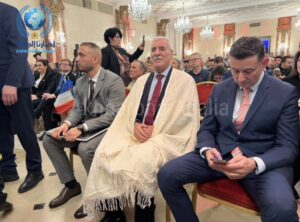
Gathered this Sunday, December 14, 2025, in Paris before an audience estimated at over 800 people, leaders of the Movement for the Self-Determination of Kabylia (MAK) solemnly proclaimed the independence of their territory, now designated as the Federal Republic of Kabylia. This event, without precedent in the political history of independent Algeria, carries a powerful symbolic weight and regional and international implications that remain difficult to assess.
A Proclamation Maintained Despite Pressure
Despite multiple attempts to prevent the ceremony from taking place, the event was successfully held at a private venue in the heart of the French capital, near the Arc de Triomphe. Initially scheduled at the Versailles Convention Center, the gathering had been banned by the prefecture of Yvelines, citing a “serious risk of disturbances to public order.”
Faced with this ban, and in the absence of a timely ruling from the administrative court seized under emergency procedures, the organizers opted for a private location, allowing the ceremony to proceed within the bounds of French law. A significant police presence was deployed around the venue to prevent any incidents.
Strong Symbolism and Notable International Presence
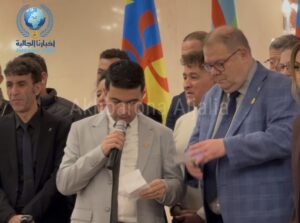
Immediately after the reading of the declaration of independence, a speech was delivered by Ferhat Mehenni, president of the MAK, now presented as President of the Federal Republic of Kabylia, followed by the performance of the Kabyle national anthem. Several speeches then marked the ceremony: foreign parliamentarians, civil society leaders, activists, and public figures—particularly from France, Canada, Israel, and the United Kingdom—took the floor to salute what they unanimously described as a “historic event.”
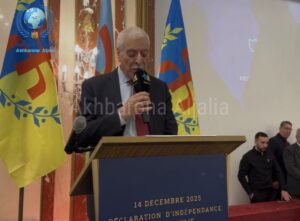
While international participation remained symbolic and without any official recognition, it nevertheless contributed to giving the initiative greater visibility. The event was widely shared on social media and closely followed by specialized media outlets and geopolitical observers.
Algiers on the Defensive
According to the organizers, the Algerian regime attempted to undermine the event by mobilizing part of its diaspora in Europe and organizing counter-demonstrations, notably through the chartering of buses from several French regions. These maneuvers reflect Algiers’ persistent unease in the face of a Kabyle claim that has moved beyond the cultural and identity sphere to enter an openly independence-driven political logic.
A Strategic Turning Point for the Kabyle Cause
The unilateral proclamation of Kabylia’s independence marks a clear shift in strategy. Previously confined to political advocacy, linguistic demands, or calls for enhanced autonomy, the struggle led by the MAK has now crossed a decisive threshold. This is an explicit political act, intended to challenge international public opinion, Western diplomatic circles, and multilateral institutions.
While no state recognition has been secured—or even announced—at this stage, the declaration opens the door to a gradual internationalization of the Kabyle issue, at a time when the regional context is already marked by significant diplomatic and security tensions.
An “After December 14” with Uncertain Contours
December 14, 2025, may thus establish itself as a milestone in Algeria’s contemporary history. Domestically, it raises the question of how Algiers will manage identity-based and political demands in an increasingly authoritarian climate. Internationally, it places Kabylia on the map of unresolved political conflicts that could emerge on the diplomatic stage.
One thing is certain: there will be an “after December 14”—both for the Kabyle independence movement and for the Algerian state, now confronted with an unprecedented political challenge since 1962.